
I decided to read the Iliad in the Richard Lattimore translation, based on a few online university reading lists. I found there was a version on Audible – and it worked well read aloud. Most of the Iliad’s 24 books took around an hour to listen to – and of course there is a certain smug self-satisfaction knowing that you are listening to it just as its original audience would have been.
The only nuisance in the Audible version was the long introduction which was also read aloud – if I were to do things over again, I would skip it on the first listen and perhaps look at it later as afterword.
I didn’t exactly come to the Iliad with a fresh mind. As a child I was an avid reader, both of Roger Lancelyn Green’s Tale of Troy, as well as the Black Ships Before Troy by Rosemary Sutcliffe , illustrated by Alan Lee. Then, of course, I was saw the very American movie adaptation, Troy and was duly outraged by it. Although I loved Eric Bana’s portrayal of Hector, I could not forgive them Paris and Helen running away to live happily ever after.
I had read fragments of Iliad – and got stuck. I stopped reading just after the fighting breaks out again after the duel of Paris and Menealos, but I remembered the scene of Diomedes exchanging his armour mid-battle, and of course Andromache’s speech.
But though I knew the plot basics, and although I had read tellings and retellings, listening to the full Iliad was still full of surprises. Here are a few valuable bits of knowledge:
- Achilles’s anger and massive sulk feel more justified in the Iliad than they did in the retellings. After all, as he himself points out this entire lengthy war is being fought over Helen. Why shouldn’t he be allowed to sulk about Briseis?
- Also Achilles has a strong emo hipster vibe. He sits and brood and plays on his lyre. Then Patroclus prepares lovely food for him. What’s not to like.
- Odysseus gives a speech to Achilles about the importance of eating before fighting, otherwise you won’t fight very well. A man after my own heart.
- The immortal horses of Achilles give him a phenomenal speech about the pointlessness of human life. It is insane and I’m sure pages and pages of criticism have been written about it. Love it.
- Poor Andromache. Her whole speech to Hector about every single one of her family members being murdered by Achilles cuts to the bone.
- The Greeks seem to think that golden tripods are incredibly valuable treasure.
- Never drive a carriage for Hector. His carriage drivers tend to die. Just not worth it.
- We all remember how terribly Achilles despoils Hector’s body. But do we remember that Hector would have done exactly the same to Patroclus’s body if Menealos had not fought him off? Worth bearing in mind.
- There’s a reason it’s called the Homeric simile. Till you read the long descriptions comparing most of the fighters to lions, and the Myrmidons in particular to wasps, you might not understand why.
The Gods will mess about with you if they feel like it. You can give them offerings, but if they are pissed off with you, it is unlikely to help you much. Seriously.
- Zeus sends a dream to Agamemnon in the guise of Nestor, telling Agamemnon that he can win Troy that day. Spoiler alert: he can’t. It’s all so that Agamemnon will be crushed to please the sulking Achilles. Hurray?
- Zeus sends Athena to persuade the Trojan archer Pandarus to break the peace. Even though both sides swore to Zeus that they would keep the peace. Zeus doesn’t care about people breaking vows to himself. Zeus just doesn’t give a damn.
- Aphrodite is not terribly nice to Helen. She basically blackmails her into going to bed with Paris.
- Athena pretends she is Hector’s brother so that he will stop to fight Achilles. Then promptly disappears. Remember, it is Hector who asked the Trojan women to send an offering to Athena? Much good did that do him.
The gods will mess about with each other. Because they can. See:
- Hera seducing Zeus so that he falls asleep, to give victory to the Achaeans.
- Hera boxing Artemis’s ears with the bow. Naughty stepchild.
- See Athena punching Aphrodite (to be fair, I spent my whole childhood wanting to see that. You go, Pallas Athena)
In short, I understand why hundreds of people have devoted their academic careers to studying this poem. It contains multitudes. I have already a acquired a paperback version for rereading purposes (though I might skip some of the long ship lists this time).
I highly recommend the ‘book by book’ summary of the Iliad by Natalie Haynes when you’re reading the poem. It made me laugh a lot.
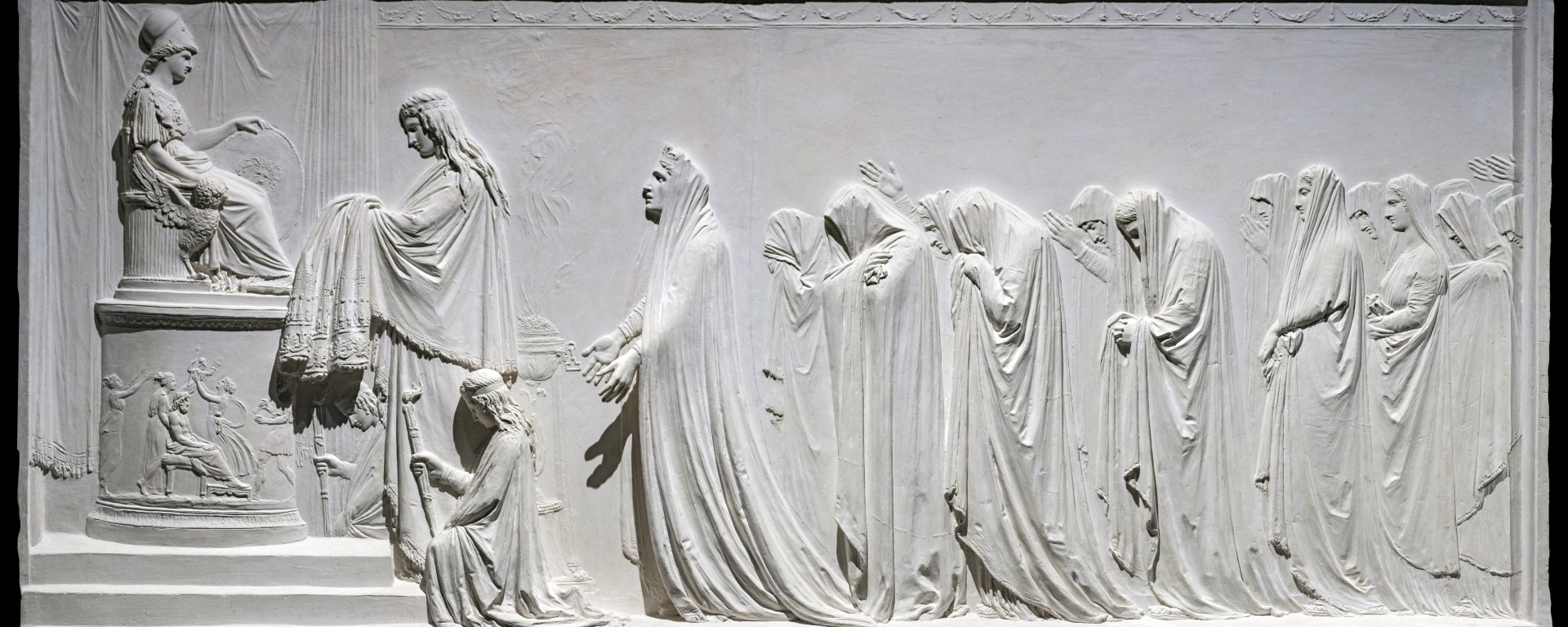
(Cover image: ‘Hecuba Offering the Robe to Pallas’ by Antonio Canova Source: Didier Descouens – Own work, CC BY-SA 4.0, https://commons.wikimedia.org/w/index.php?curid=81934399)
 litcritpop